



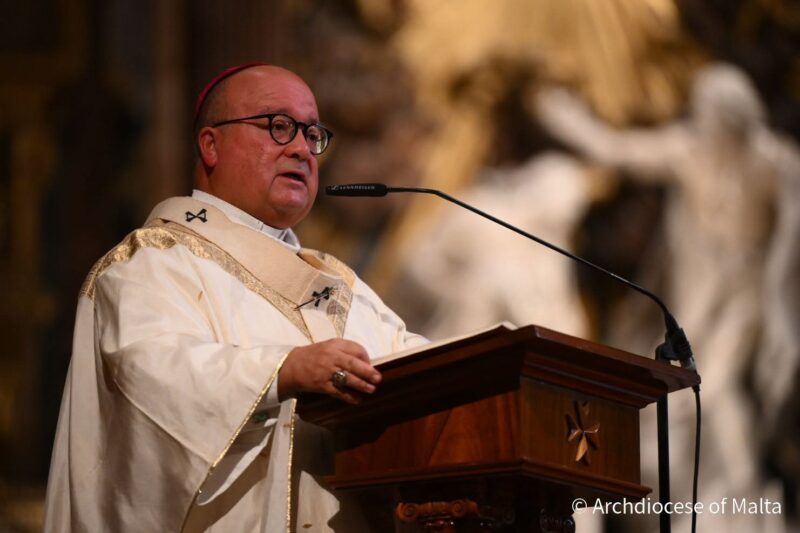
In recent weeks, Archbishop Charles Scicluna and Bishop Joseph Galea-Curmi have spoken plainly about some of Malta’s most urgent challenges: truth and lies, integrity and corruption, the influence of money and informal networks, the environment and the country we are leaving to future generations.
Some of these words are uncomfortable. Perhaps they should be.
The Church is called to proclaim the Gospel without fear or favour, and that Gospel has consequences for how we live together and treat each other. The Church cannot retreat into the sacristy when fundamental questions about human dignity and the common good are at stake. As Pope Leo XIV recently highlighted on his way back from his apostolic trip to France, when the Church speaks about questions of social doctrine, “we’re not entering into politics, we’re applying the Gospel to people’s lives”.
At the State of the Nation conference, Archbishop Scicluna described networks in which money, access and favours circulate until the State itself is captured by these interests. On Independence Day, he called for institutions strong enough to protect the common good and for people willing to put duty before “money, influence, friendship or favour”.
On Victory Day, Bishop Galea-Curmi spoke of the “victory of truth over lies” and the “victory of integrity over corruption”. He also warned that organised crime can subvert justice and that there is no victory if our children breathe polluted air.
Too often, such interventions are reduced to a single question: Who are the bishops attacking? That drags the discussion back into the partisan trenches we desperately need to leave. This is not about attacking one party or another. The more important question is what these words ask of all of us, including the Church herself.
We cannot demand integrity, transparency and accountability from others while exempting ourselves. Archbishop Scicluna acknowledged as much: when Church leaders fail, the Church’s witness becomes hollow. A Church that speaks about integrity must strive to practise it and, when she fails, must be humble enough to admit it, learn and make amends.
Nor should we mistake clarity for hostility. Christian truth is inseparable from charity, and we need to recover a way of speaking that refuses both silence and aggression towards our perceived enemies.
The multiple challenges highlighted by our bishops can only be adequately tackled if we manage to reverse the extremely damaging corrosion of trust we are witnessing in our society. And, for this to happen, institutional reform is necessary but not enough. What is needed is a culture of truthfulness and integrity in which trust can flourish.
When people repeatedly see connections rewarded over merit, influence over justice and short-term advantage over long-term responsibility, distrust takes root. Citizens lose faith in politicians and institutions and, eventually, in one another. The prevailing attitude becomes: Everyone is looking after themselves, so why should I behave differently?
When this happens, those with money, influence and connections usually find ways to protect themselves. The vulnerable and the voiceless, including the environment and future generations, suffer most.
Recovering trust in politics, in our institutions and in one another is therefore a shared responsibility. It means challenging the networks of influence that undermine democracy and the common good but also examining how each of us exercises responsibility in our own sphere.
Honesty, integrity and service must be virtues we practise, not merely values we demand from others.
The Church will play her part with humility about her failures, charity towards those she disagrees with and courage to speak when human dignity and the common good are at stake.
There are moments when prudence calls for silence. There are also moments when fidelity to the Gospel requires us to speak.
At such moments, silence is not golden.
Mark Cachia
This article first appeared in the Sunday Times of Malta (04/10/2026)