



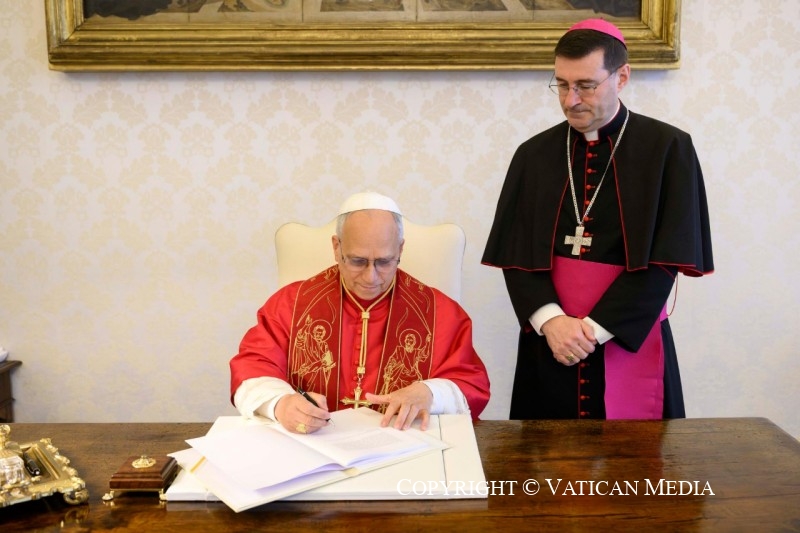
On May 15th, Pope Leo XIV issued the encyclical Magnifica Humanitas (MH), offering the guiding principles needed to confront some of the most pressing questions humanity faces in this age of artificial intelligence:
1) Where are we heading?
Without deliberate and urgent intervention, Leo XIV warns us that we risk what he calls the “Babel syndrome” — a world enslaved to profit, where human difference is flattened into data and a single digital logic claims to explain everything, even the mystery of the human person.
2) What makes us worthy?
Magnifica Humanitas names an insidious ideological danger: the tendency to link human worth to productivity and efficiency. When this becomes the ultimate standard, people begin to see themselves as projects to be optimized rather than persons made for relationship and communion (MH 112). The encyclical warns directly against any system that attributes greater value to those who are more effective or efficient (MH 51).
At the heart of the document is a simple, non-negotiable conviction: dignity cannot be earned, measured, or granted by any algorithm. Every person is created in the image of God — planned, willed, and called into communion with God, others, and creation (MH 50). That dignity is universal, inviolable, and — in Leo XIV’s own word — infinite (MH 53).
3) Who is in control?
One of Magnifica Humanitas’s sharpest warnings concerns the concentration of digital power. A handful of companies now control the infrastructure of modern life — data, platforms, algorithms, and the mechanisms that determine what people see and what gets ignored. As Leo XIV puts it, technological power has taken on an unprecedented private character, making it harder than ever to direct it towards the common good (MH 5).
The stakes could not be higher. When power drifts beyond democratic accountability, the excluded and powerless pay the price. They always do.
Without real individual and democratic control over personal data, the digital age risks becoming, in Leo XIV’s words, colonialism in another form (MH 178).
4) Should we get rid of our human limitations?
Faster is not always better. More powerful is not always more human.
The encyclical pushes back against the assumption that human limits are problems to be engineered away. Vulnerability, wounds, scars — these are not flaws. They are the foundation of authentic human life. As Leo XIV writes, “For an algorithm, an error is a flaw to be corrected; for a person, however, it can be a catalyst for profound change” (MH 128).
Limitation is not something to eliminate. It is the space where growth, maturity, and grace become possible.
5) Is the search for truth still possible?
When every answer is a click away, the patient search for truth becomes harder to sustain. When it is controlled by platforms and shaped by algorithms, truth risks becoming a commodity to be bought and sold rather than a key element in the search for common good.
The consequences are political as well as personal. Democracy depends on a shared commitment to reality, and as the encyclical puts it, “the search for truth is an essential element of democracy” (MH 134). The warning that follows is blunt: indifference to truth leads, slowly but surely, toward totalitarianism (MH 134).
Leo XIV’s response to this challenge is countercultural: critical thinking, independent journalism, transparency — and the wisdom to know when to disconnect. Sometimes the most important digital skill is stepping away from technology to think, reflect, and remain free (MH 140).
6) Should AI make life or death decisions?
Few developments raise sharper ethical questions than AI in warfare.
By reducing human beings to data points, AI risks making violence more impersonal and therefore more acceptable. Pope Leo therefore insists in MH that decisions involving lethal force can never be outsourced and must remain human decisions.
7) Is there still space for social justice?
Magnifica Humanitas leaves no room for ambiguity: social justice is not optional for Christians — it is an integral part of discipleship: “For the Christian community, social justice is a concrete way of following Jesus and remaining faithful to the Gospel” (MH 79).
Faith, in other words, must become action — shaping a world where no one is excluded and the fruits of human creativity are shared justly. At its core is a call to solidarity: progress must serve everyone. It cannot be built, as the encyclical starkly puts it, on human bodies that are “scarred, injured and worn down so that computational flow may continue uninterruptedly” (MH 173).
Conclusion:
To guide us forward, Leo XIV reaches back to Nehemiah — the prophet who returned to Jerusalem to find the walls in ruins and the people in despair. He didn’t rebuild alone. He assigned each person their own section of the wall and called the whole community to the work together.
The proposed direction, then, is neither withdrawal nor panic. It is not passive hope that technology will regulate itself, nor a blanket rejection of AI as inherently dehumanizing. It is something harder and more demanding: engaged, collaborative, morally grounded stewardship of this challenge and opportunity.
The encyclical is concrete about what this requires. Leo XIV calls for responsible planning, honest assessment of human and social impact, inclusion of the most vulnerable, digital literacy, and research guided by justice and peace (MH 14). These are practical criteria, rooted in Catholic Social Teaching, that can and must be applied urgently to how we govern technology.
The choice before us, as Leo XIV puts it, is stark:
“The task that stands before us is that of being builders of communion, rather than architects of Babel. We are to be servants of the coming Kingdom, instead of lords of towers destined for ruin.” (MH 16)